· 4 min read
How many croissants is your indoor ride?
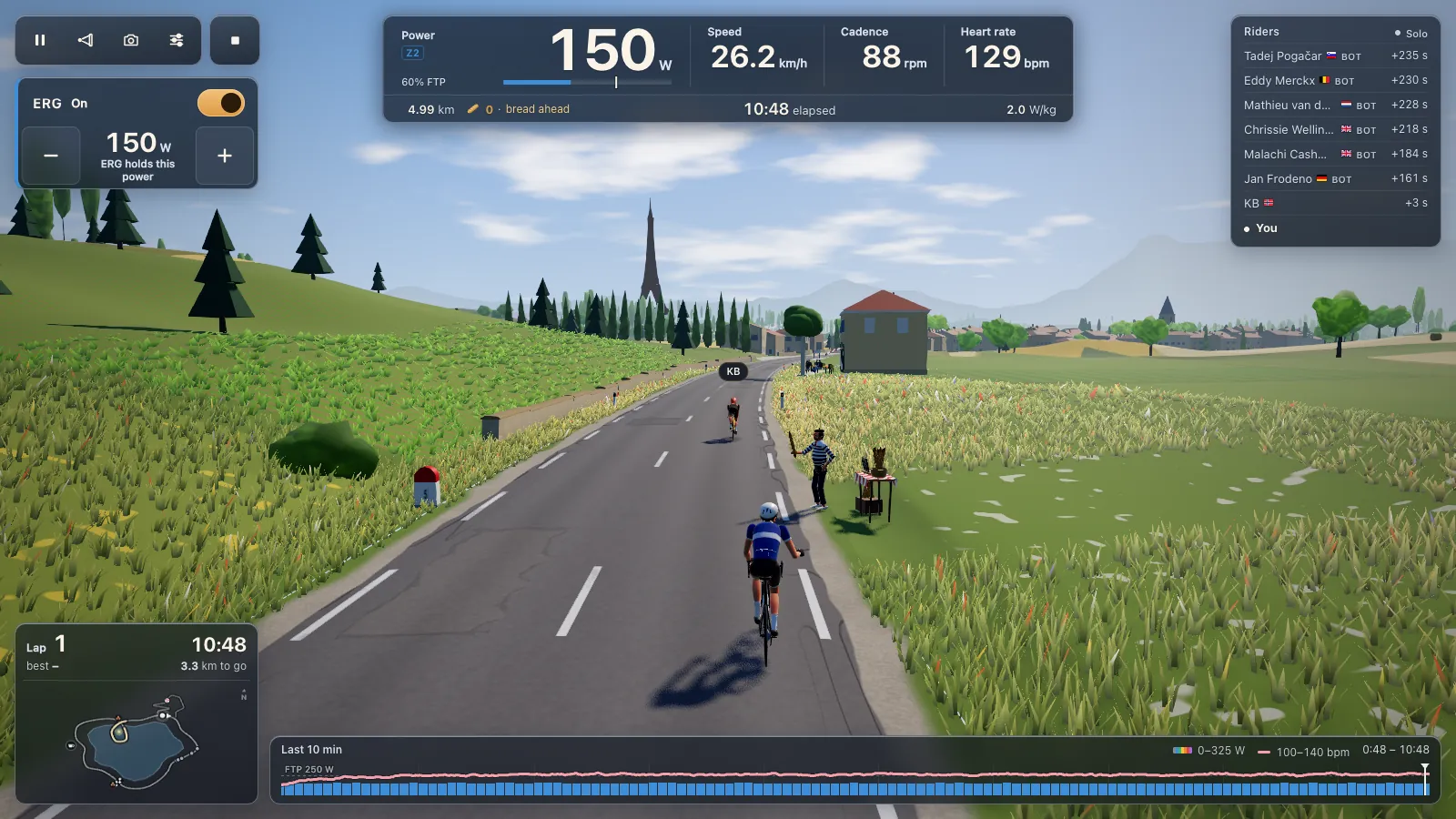
Your indoor ride in croissants is easy to work out once you know one trick: on a bike, the work you do in kilojoules (kJ) is close to the food energy you burn in kilocalories (kcal). An hour at 200 W is 720 kJ, so roughly 720 kcal, or about three croissants. Below is the table for rides from 100 to 300 W, with a lap of Tour du Pain's lake and a climb of the Col du Pain added for fun.
Why kJ is roughly kcal on a bike
A power meter or smart trainer measures the work you put into the pedals. Watts times seconds gives joules, so 200 W for 3,600 s is 720,000 J, or 720 kJ.
Your body isn't that efficient. Most of the energy you burn turns into heat; only about a fifth to a quarter reaches the pedals. That share is called gross efficiency. A kilocalorie is 4.184 kJ, and 1 ÷ 4.184 is 0.24, so at 24 % efficiency one kJ of work costs exactly one kcal of food. That's where the rule of thumb comes from.
It's a rough rule. A 2013 study in Medicine & Science in Sports & Exercise measured national-team cyclists at about 18.5 % efficiency and suggested multiplying work by 5.3 to get energy burned, which works out at about 1.27 kcal per kJ. So if anything, the croissant counts below are on the low side: add a quarter if you want the study's number.
The food we're counting
We used the USDA's FoodData Central, the US national food database. A butter croissant has 406 kcal per 100 g, and the database lists a medium croissant at 57 g: 231 kcal. French bread has 272 kcal per 100 g. A baguette in France typically weighs about 250 g (Wikipedia notes no law fixes it), so one baguette is about 680 kcal.
The table
Work in kJ is plain arithmetic: watts × minutes × 60 ÷ 1,000. Croissants and baguettes use the 1 kJ ≈ 1 kcal rule.
| Ride | Work | Croissants | Baguettes |
|---|---|---|---|
| 100 W for 30 min | 180 kJ | 0.8 | 0.3 |
| 100 W for 60 min | 360 kJ | 1.6 | 0.5 |
| 150 W for 60 min | 540 kJ | 2.3 | 0.8 |
| 200 W for 30 min | 360 kJ | 1.6 | 0.5 |
| 200 W for 60 min | 720 kJ | 3.1 | 1.1 |
| 200 W for 90 min | 1,080 kJ | 4.7 | 1.6 |
| 250 W for 60 min | 900 kJ | 3.9 | 1.3 |
| 300 W for 30 min | 540 kJ | 2.3 | 0.8 |
| 300 W for 60 min | 1,080 kJ | 4.7 | 1.6 |
| 300 W for 120 min | 2,160 kJ | 9.3 | 3.2 |
| One lap of the lake at 200 W (about 15 min) | 181 kJ | 0.8 | 0.3 |
| One Col du Pain climb at 250 W (about 4 min 19 s) | 65 kJ | 0.3 | 0.1 |
The lap and the climb times come from the game's own physics for a 75 kg rider on an 8 kg bike, riding alone at steady power. The Col du Pain is short: a hard climb at 250 W is worth less than a third of a croissant. We're sorry.
Game bread is a different thing
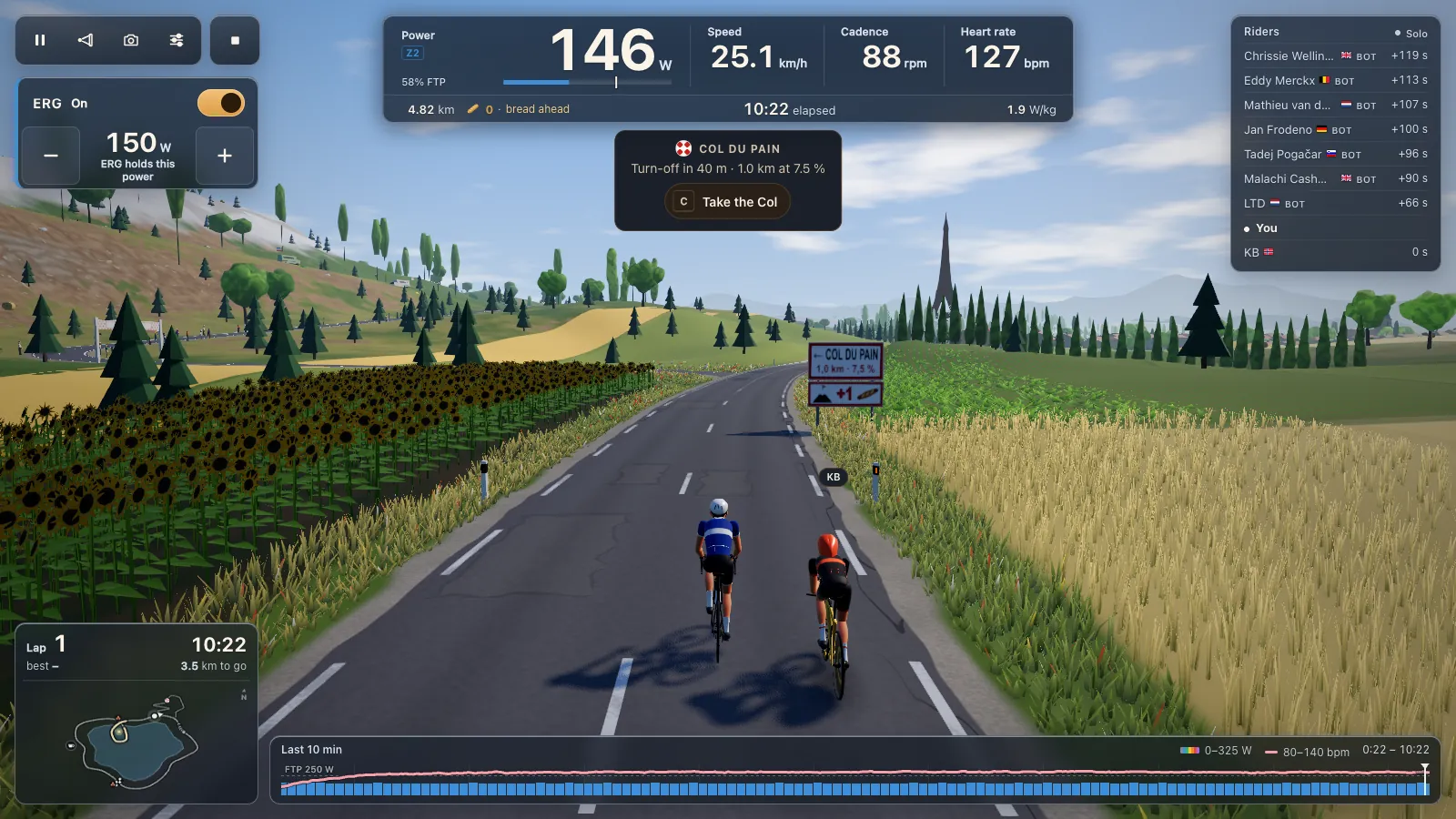
Tour du Pain has its own bread, and it isn't food. The game hands out a baguette for every 5 km you ride on your own legs, and since 4 November one extra baguette for each climb of the Col du Pain. In free ride a Frenchman holds it out at the roadside; in workouts the bakery van pulls up beside you at the 5 km marks.
The game is more generous than your stomach. An hour at 200 W covers about 33 km on the loop in the game, so that's six game baguettes. In real food the same hour burned about one baguette's worth. Please don't eat six.
Where to find your own kJ
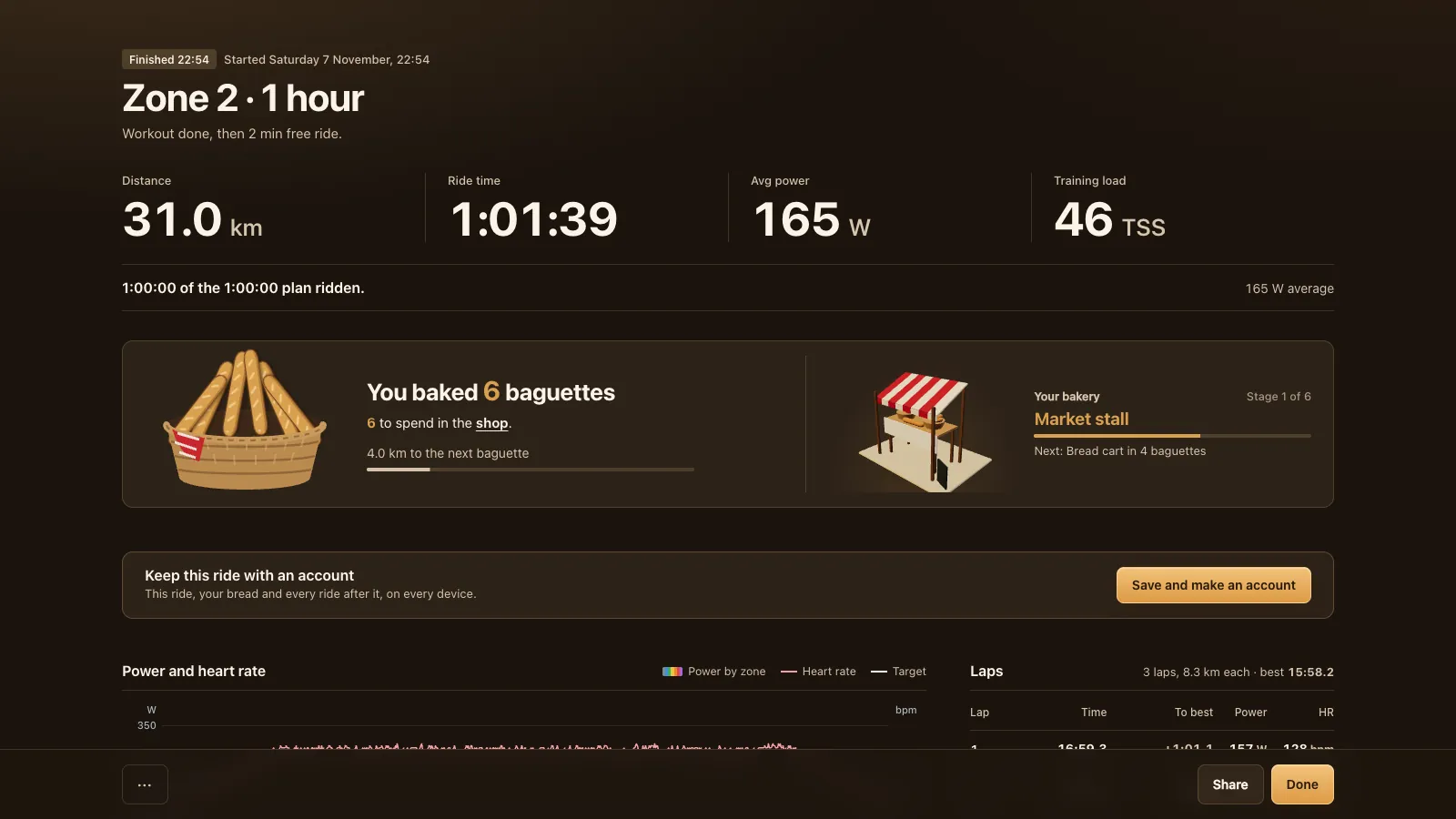
Tour du Pain records your power second by second, and every ride gives you a .fit file. Upload it to Strava, Garmin Connect or intervals.icu and you'll see the total work in kJ, often labelled as energy output or calories. If an app shows "calories" equal to your kJ, it's using the same rule of thumb.
Structured ERG workouts are the easiest way to hit a number in the table: the trainer holds the watts, so an hour of 200 W is really an hour of 200 W.
A few honest caveats
- This counts the energy your legs used, not your whole day. Your body burns energy sitting still too.
- Efficiency differs from rider to rider, roughly 18 to 25 %, so treat every number here as a good estimate, not a measurement.
- Croissants vary a lot. A big bakery croissant can be 80 g or more.
If you want to earn the game bread without a trainer, the demo lets you ride a few minutes on the keyboard.
Sources
Checked on 8 November 2026: USDA FoodData Central, croissants, butter (406 kcal per 100 g, medium croissant 57 g), USDA FoodData Central, French or Vienna bread (272 kcal per 100 g), Wikipedia on the baguette (about 250 g in France), and the gross efficiency study Energy expenditure of constant- and variable-intensity cycling: power meter estimates (about 18.5 %, work × 5.3). The game's bread rules are in the update log.